Showing posts with label astrology. Show all posts

Thursday, 19 December 2013

Astrological Energies of the Winter Solstice 2013:

 Working to find a middle ground for our global family unit.


This year's Winter Solstice will prove to be very interesting for human consciousness and its spiritual awakenings.

  As always the Winter Solstice occurs as the Sun moves into Capricorn highlighting the potential for success, and the 'right way of doing things'. There have been many crises that have occurred this year such as the ongoing global debt crisis; political repression and the general dissatisfaction of the world community; the humanitarian crisis in Syria, as well as extreme weather events leading to catastrophe such as the Philippines Typhoon.

http://www.esoteric-art.co.uk/Store/index.php?route=product/product&path=61_66&product_id=66
  The Sun in Capricorn helps us to keep calm and methodically and patiently achieve our objectives. Now we can get through a mountain of work if we have to, and through patience put new structures in place. With the UK position of the Sun being in the 6th house, the  workplace is where our organisational skills and ability to serve others really can come to the fore. This can go a long way towards helping to alleviate the sufferings of humanity. The only problem is the health of our own economy is drained and the outlook may be still fairly pessimistic contrary to what the government tells us. However, Capricorn likes to do things that are worthwhile—and like other Earth signs, needs to feel valued and favourable in the world in order to be fulfilled.  The UK could gain recognition on the world stage by having a better ability to appreciate what motivates human society and its set of ideas, principles, and agreements, and that it can be an essential and integral element within that framework.

  This is an excellent time to be resourceful, take more responsibility  and become more creative when it comes to the well being of the planet. With the Sun and retrograde Venus making positive aspects to the star of Scheat we need to push forwards with grand schemes and plans about becoming more self supporting and sufficient even if some of the ways of thinking are unconventional.

  Also, we have an aspect pattern between Jupiter, Pluto and Vesta reaching its peak on the same day as the solstice. There are vast energies at work here trying to search for an outlet for expression. If used wisely it can be the time for great accomplishments. Retrograde Jupiter located in Cancer helps us to feel as though the world is our family and there will be a strong urge to look after this family either through more concern and compassion; or by giving money to lessen mass distress. However, our determined efforts may mean that we are willing to stray from the correct way of doing things. We may be over forceful with opinions even though they may actually be right!  This is because these energies bring to the fore a style of communication that seems closed off, extremist or downright weird. Finding a middle ground is better at this time and it may be more worthwhile to create change from within rather than trying to tear down the whole structure of something just to make a stand.

  Every creature has a purpose of presence. The power of love and sympathy for the suffering of others often including a desire to help; for all living beings creates confidence and reliance on good qualities - especially fairness, truth and honour all over the world. Humanity needs to see itself as a rough diamond that now needs polishing. It is the time to look at how we can improve ourselves through small changes that make us more effective and better ourselves to reach a higher potential.

  It is impossible to avoid or to prevent from happening the repetition of events the like of which we have witnessed recently, but what we can do is to start to see these events helping us to extend beyond or transcending the personal and the ego; to recognise ourselves as a family of human beings, living together and functioning as a single unit, related in origin and as one organism, adapting and responding to change together, as one in joint effort.

Lisa Gates - Spiritual Counsellor, Healer, Astrologer and Psychic Medium

01949 845157

lisa@lisagates.co.uk
www.lisagates.co.uk


© 2013 Enlightening Times All Rights Reserved

Wednesday, 6 February 2013

Astrology and Power by David Rowan

In a profound sense, the most potent power is found in the absence of force; the greatest power is to master yourself - the greatest mystery is how to do it. The greatest fear is to know well yourself - the greatest strength you'll ever know is to change your inner world ...


In Astrology, different types of power are represented by different symbols: The Sun, Jupiter, Mars and Pluto symbolise the fiery, most observable forms of power. Neptune, Venus and the Moon represent the dynamics of love and Mercury and Uranus represent different octaves of thought and comprehension. Each of these symbols represents many meanings (they are polysemous) and they can be grouped in a variety of different ways. This note, as the title suggests, is about power. The confines of this medium means we can only take a cursory glance; in my classes we would discuss each of these symbols; the Sun, Mars, Jupiter and Pluto, each for three or four days - here, one has to be concise, rather than thorough and although this means we cannot explore them in great detail, it is possible to glance through the window into the realms of power ...

The Astrological symbol for the Sun is a dot within a circle:

 It is reported that modern theologians have looked at the biblical expression, 'God made man in his own image', and concluded that if anything, God is word we use to describe the generative force of the power of creation. Whether you follow the notion of, ' man in god's image' or the Hermetic perspective of, 'As above so below', the conclusion is that the nature of being human is one of being a generative force. .. We are generative, creative beings and we each have authorship of the pathways of our lives (including casting ... lol). We have no innate power over external people or events, though we can have influence and employ persuasion, seduction, ruthlessness, enthusiasm, fear and common sense logic to charm, enchant, captivate, order or control; these may, or may not, be enduring and those which employ some form of force may be ultimately unsatisfying and ineffective in a long-term or deeper sense. We do, however, have the inner power, at some level, of determining how we respond to circumstances and what we can draw from even the most arduous experience. A lot of our reactions to experience are coloured by unconscious, conditioned (learned) responses and, with certain techniques from modern applied psychology, these can be adjusted, changed and re-designed. One of the greatest sources of inner power is knowing, not just intellectually, but viscerally knowing that we are the authors of experience. The steps and decisions, responses and reactions we took in the past has led to where we are now; it is true to say, is it not, that every single thing you have ever done in your life a has led you to reading these words right now ... and how  you react or respond to these words, the internal narrative you are having, the inner-images you are seeing, will colour the orientation of the next steps you take into your future ...


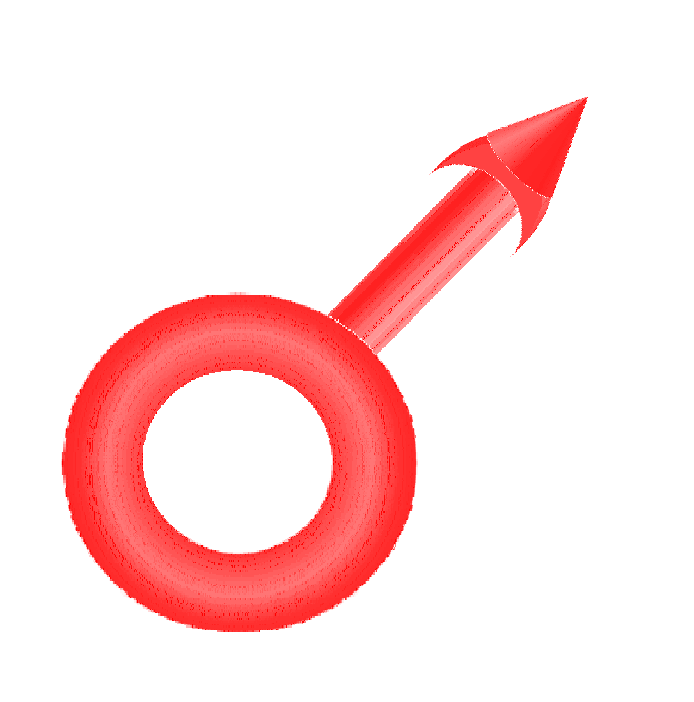
The Astrological symbol for Mars, is that of an arrow reaching out from a central point; a circle ...

The power of self expression is inherent within all life forms; the reaching of a flower toward the sun, the reaching of a hand toward an apple ... when we express our nature we take our place in the scheme of creation - however, self expression can take many forms and it may be wisest to do so as if one has kindness set as the default in one's heart ...

In the human experience, self expression can be thwarted: inhibited, dominated, controlled, modified, adapted, suppressed, oppressed, repressed etc. Self expression can also be directed: assertion, exuberance, enthusiasm, creativity, initiative etc. It is my astrological opinion that depression, which is different to sadness or even a forlorn absence of hope (things symbolised by Neptune); depression has two primary roots; symbolised by Mars and Saturn and this perspective on depression is best explored in an article in its own right. At least, that is what I believe ...

The Astrological symbol for Jupiter is a crescent, poised at the start of a sojourn through time and space, represented by the cross of matter:


During our journey of life through time and space we think we have free-will, but perhaps complete free-will is an illusion. Our brain is situated within a neurochemical environment ... our comprehension of reality; the narrative of meaning we give to what we experience,  is situated within our epigentic potentials, our personal history to date, our ontological position, our socio-affective environment, our immediate social relations, our culture; memes and discourses, our politics and ideology, our national and spiritual identity ... all of which form the building blocks of what we believe to be true. Beliefs are very powerful and form the context within which we conduct the making of meaning; we then form decisions based on what we believe to be true  and act upon these decisions whilst believing our understanding of reality to be a an unshakable fact - the Truth. There are currently 6.9 billion humans on earth, each with their own niche viewpoint of the universe and unique perspective on 'reality'. We are, however, relational beings and form alliances based on the common ground of our shared reality. We do not share all of the model of our own niche reality, much of it is unconscious ... this description of reality is, of course, not true; it is a statement of my current beliefs about the nature of our, or rather my, reality ...

The Astrological symbol for Pluto shows the circle of the spirit, elevated above the crescent of the soul which is established above the cross of matter ...

From an esoteric perspective, this symbol represents the  'rightful' order of things ...  however, if the Soul/psyche has some intellectual, psychological or emotional distortions, or unresolved issues, in its dynamics there may be a gap between 'what is' and 'what seems to be'. The symbol of Pluto shows everything in perfect alignment. If we have moved away from our true spiritual path then your inner being will bring those facets of your life back into alignment by influencing your unconscious to create, through behaviours and actions, the perfect environment in which those issues can be clearly identified and worked with. In other words, we somehow conspire to make our circumstances 'fit' the issues we need to learn, and, like a 'cosmic tuning fork' our inner-being resonates with the external circumstances and the 'trapped' feelings come to the surface for transformation and re-integration into the psyche.

The symbol of Pluto shows us the natural order of things from the perspective of life within spirit; a window upon the land of light from which we emerge into this life and to which we return as this journey passes into the greatest adventure of all.


The word transformation, describes the process in which something changes form; thee old passes into something new ... Empowerment describes an experience of being conscious of  our ability to play a role in the shaping of our life and the path we are taking. C J Jung once said, 'Some things cannot be changed, they are merely out grown'. Change can often seem disempowering and yet we can step into empowerment by embracing change and using it as an opportunity to write a new chapter in life ... Death is a word we use to describe an ending, however, endings are the prelude to new beginnings; when winter dies, spring is born .... the death of spring heralds the birth of summer; the death of poverty is the birth of wealth - the death of wealth is the birth of poverty ... when a caterpillar dies a butterfly is born ... Change is the only constant, and the only thing one can guarantee in life. Everything flows in cycles and every point in a cycle has its season. When change is occurring one can mourn the passing of the old by casting the attention of one's eye to that which is passing - or - one can instead, place the eye of one's attention to designing the new chapter; how best to draw the best from new circumstances and what actions can one take in order for the new chapter to be even better ?  ... how can I change myself in order to blossom in the spring of new change ... :)


 For an overview of the symbols of all the planets and what their shapes mean, please click here:


For a series of short videos explaining your personal astrological birth cart, please click here:


For a list of what I can tell you from  your birth chart, and the full range of topics I discuss with you in a life-reading, please click here:

and, if you find you life the breadth or depth of these philosophical musings from my understanding of astrology and would like to learn and chat about life on this, and a deeper level, you may be interested in  my online astrology course. A waiting list of those who are interested and wish to register


In kindness

Dave


© David Rowan, September 2011
Dance around the Sun cover art


A human being is part of the whole, called by us 'universe,' a part limited in time and space. He experiences himself, his thoughts and feelings, as something separate from the rest -- a kind of optical delusion of consciousness. This delusion is a kind of prison for us, restricting us to our personal desires and to affection for a few persons nearest to us. Our task must be to free ourselves from this prison by widening our circle of compassion to embrace all living creatures and the whole of nature in its beauty. Nobody is able to achieve this completely, but the striving for such achievement is in itself part of the liberation, and a foundation for inner security’.

 Albert  Einstein

Monday, 5 December 2011

'Self Correcting' - a dynamic of conceptual processing within the Autistic Spectrum by David Rowan

Website
Autism can be thought of as a spectrum, ranging from subtly mild at one end to full at the other; from mild dyslexia to full autism.

Different parts of the spectrum hold unique qualities and yet those further along the scale also hold some of the qualities of those from the earlier milder areas of the spectrum as well; these qualities may also vary in depth or strength; all of these conditions, from very mild dyslexia to full autism are a part of what is known as The Autistic Spectrum.

When had my first university Asperger's/Dyslexia assessment in Southampton in 2002, they discovered I had a  particular dynamic in my thought processing which they called 'Self Correcting'. This was considered to be so disadvantageous to my forthcoming work as a student, that I was awarded a support worker who would check all my work for grammatical errors and typos, like a university appointed proof reader. My tendency for self correcting prompted a great deal of concern ...

What is it ?

On the surface, 'Self Correcting' sounds like it describes a person proof reading themselves; typing some words, checking for errors, identifying errors, and then correcting the errors ...

However, it is not ...it is much more

The first step to understanding Self Correcting is to identify the location of the correcting. What I mean is this;

In the above example of correcting errors, proof reading oneself, the correcting process is external. The brain coordinates the eyes and hands to produce text. The eye scans the text and the brain identifies parts of the text which are incongruous to remembered text-rules. The brain the navigates the hands to physically touch the keys of the physical external keyboard, so that the outer reality is adjusted to meet the remembered text-rules; spelling and grammar. The person has self-corrected the text.

The term, 'Self Correcting', describes a completely different process.

In Self Correcting, the correcting is located in the brain; within the neural processing itself.

Here, the brain coordinates the eyes and hands to produce text. The eye scans the text, and light from the page stimulates the optic nerve, as it does in the self-proof-reading example, however, the attention of the individual, what some might term, 'the mind's eye', is not focused upon the details of the external text. It is, instead, focussed upon the memory of what the individual has just written. the inner eye is not looking at the actuality of what has been written; it is looking at the memory of what the individual wanted to write.

The text just written may have errors, it may have no errors, but the individual cannot 'see' the text - they can only  'see' the memory of their intention. Think about that for a moment, they can only see their memory of their intention ...

All while the individual can remember their intended text, what they wanted to write, they cannot see it objectively; all they can  'see' is their subjective text.

What I find is that if I look at something I have just written, I cannot see the errors - they are invisible to me. However, if I leave the text for some time, or distract myself by thinking about something completely different, the resultant amnesia means that when I next look at whatI have written, I see the text through fresh, objective eyes - and I can the see the actual words my hands produced and the errors are plainly visible..

You may notice on here that I sometimes write a status post, and then delete it, replace it, delete it and replace it again - this happens when I have written something, got distracted and then blushed when I see the errors my dyspraxic hands have produced.

I can see the errors in other people's writing because i am not privy to the memory of their intention; in other words, because I am not aware of what they wanted to write, my inner eye is not beguiled by the memory - so my attention rests upon the physical page and sees what is actually there. This is then compared to the grammatical rules stored within my unconscious, and I am able to spot text which is incongruous to the rules of which I have knowledge.

I thought it would be interesting to post the following question on facebook:

'a question for those with Dyslexia: do you find you are able to spot typos and errors in the writings of other people ?'

Every reply confirmed the same; those with dyslexia who cannot see their own errors, can see them in the writings of other people. This suggests that those who replied are Self Correcting.

For me, this Self Correcting mechanism, or neural dynamic, has boarder implications.

If we stop thinking of the Self Correcting process as something related with writing, and instead view it as a neural process, then it becomes clear that the disparity between viewing the external world objectively for what it is, and attending to the mind's inner concept of 'what is', may have more general implications.

For example, if I expect the stairs to be a clearway of ascending steps which lead to the upper landing, all I 'see' is a 'clearway of ascending steps which lead to the upper landing'. If there is something placed  at the foot of the stairs, I literally do not  'see' it; really - even if I have to make an effort of climbing over it, or navigating around it, my inner vision is fixated on the memory of my intention - to arrive at the upper landing, and that is all I 'remember' afterwards; my ascending journey along clearway of  steps to the landing ...

If the TV screen is covered in dust, I do not see the dust; I see,  'that which I am looking for', which is the electrical picture emanating from the screen.

This Self Correcting processing can be useful in certain contexts; when I look at someone's face I rarely see their spots and blemishes ... (until they point them out). Navigating your way through a world of expectations, can be bewildering, entertaining, socially disadvantageous and even downright dangerous. Not seeing the car as you step into an expected clear road, not seeing the open manhole :) ...
Not seeing a friend's face as they pass you in a busy street is inconvenient - not seeing the temporary mess of a local roadwork's is convenient. Not being able to do your shopping because the supermarket has moved the shelves around and changed the colours of their packaging is very inconvenient - being able to clearly remember the circumstances of a difficulty and its associated feelings and thoughts, described by a client in a therapy session is very convenient. Forgetting someone's name but remembering their Moon sign is ...

I cannot read music, but I can play guitar because I learn the shapes of chords and the patterns of scales - though, I rarely have a clue what the names of the chords or notes are.


if you'd like a little technicality of the neuroscience of the 'inner vision', or, 'mind's eye' ...

In neuroscience, units of perceptions, such as the stimulation of the optic nerve when light touches the retina, are known as 'percepts' A percept is a component of a perception.

Percepts, such as the stimulated optic nerve, go to the rear of the brain and then loop around and around. If they have sufficient intensity an awareness of them emerges and they become 'concepts'. Concepts are units of consciousness.

When we look at a tomato, we  'know' the tomato is on the outside of ourselves; a real physical tomato in the real physical external world.

When we remember a tomato, we somehow 'know' we are not looking at one, on the 'outside'

How ?

The name given to the knowing of what we know, neurologically is 'Qualia'. Qualia is the way neuroscientists discuss how a brain distinguishes the difference between, for example,  various shades of blue. Qualia is a mystery, as is much of the brain, and although the  technologies of the last decade have produced a great deal of new understandings of the brain, we are still at the stage of formative investigation.
I’d like to paste an extract from one of my papers here ...

(This may get a little technical, but it’s absolutely fascinating ...)


' The Narrative Self:

Stephen Pinker attests that humans have an instinct for language; ‘Language is so tightly woven into human experience it is scarcely possible to imagine life without it’ (Pinker, 1994, p.17). Words are not merely symbolic conveyers of ideas or meaning; the phenomena of language is a construct of what may be considered to be that which defines being human; a complex and sophisticated consciousness of self (Dennet, 1991, p.191).  Consciousness does not appear to arise from any single region or neural network of the brain, but appears to be an emergent function which arises from the integration and synchrony of cycles of neural processing (Cozolino, 2002, p153). In The Feeling of What Happens, Domasio describes the emergence of narrative as a process which begins with a proto-conscious core self:

'…neural patterns which become images, images being the same fundamental currency in which the description of the consciousness-causing object is also car­ried out. Most importantly, the images that constitute this narrative are incorporated in the stream of thoughts. The images in the con­sciousness narrative flow like shadows along with the images of the object for which they are providing an unwitting, unsolicited com­ment. To come back to the metaphor of movie-in-the-brain, they are within the movie. There is no external spectator (Domasio, 1999, p171).'

Domasio asserts the autobiographical self is constituted by implicit memories of multiple instances of past experiences which grow continuously and may be partly remodelled to reflect new experiences. Sets of memories which describe identity and person can be reactivated as a neural pattern and made explicit as images (Domasio, 1999, p.174). Edelman and Tononi confer, describing the formation of the autobiographical self as, ‘the remembered present’, a higher-order of consciousness which can place itself in a scheme of the past, present and anticipated future, which, in its most developed form has a semantic and linguistic capability (Edelman and Tononi, 2000, p. 103).'

The architecture of the brain is not completely static and fixed. The term, ‘Neuro Plasticity’, is used to describe how the brain’s shape is changed when different cells are used, a bit like making a new path in a field of soft tall grass. The more the path is used, the more ingrained the pathway becomes. If it falls out of use it can disappear. Yes; a whole chain of thought, an idea, can literally vanish from your head. American neuroscientists have coined the phrase, ‘use it ... or lose it’.

So, the shape of our brain determines how easily we may, or may not, express facets of our character, including problem solving abilities and the options of thoughts we may have. Obviously, when faced with a challenge in life, the more choices we have through the soft ling grass, the easier it may be to find a way to overcome the challenge and thrive.

Less thought options = less choices = higher chance of failure or becoming stuck.

More choice options = more choices = higher chance of success ... finding new horizons ... and survival.

What creates the thought options ?

Brain activity

What stimulates brain activity ?

Our actions, the environment, and narrative; words.

What stimulates the brain with words while also providing us with new words, which are new thought choices, new pathways ?

Books.

Bibliography: the books mentioned above (and a few more you may enjoy ...):

Bowlby, J., 1979, The Making and Breaking of Affectional Bonds, Tavistock Publications

Capra, F., 1996, The Web of Life, HarperCollins.

Cozolino, L., 2002, The Neuroscience of Psychotherapy, W.W. Norton and Company inc.

Domasio, A., 1999, The Feeling of What Happens, William Heinemann.

Edelman, G M, Tononi, G., 2000, Consciousness: How Matter Becomes Imagination, Allen Lane The Penguin Press.

Grinder, J., Bandler, R., 1981, Trance-formations, Real People Press.

Guastello S, Koopmans M, Pincus D, 2009, Chaos and Complexity in Psychology, Cambridge University Press.

Jackendorff R, 2007, Language, Consciousness, Culture; Essays on Mental Structure, The MIT Press.

Kirkpatrick L A, 2005, Attachment, Evolution, And The Psychology of Religion, The Guildford  Press.

Pinker S, 1994, the Language Instinct, penguin Books.

Sacks O, 1995, An Anthropologist on Mars, Picador.

Schore A N, 2003, Affect Regulation And The Origin Of the Self, W.W. Norton & Company, Inc.

Watson P, Ideas: 2005, A History from Fire To Freud, Weidenfield & Nicolson.

and I recently found ...

Autism and the Edges of the Known World: Sensitivities, Language and Constructed Reality - Bogdashina

Memory in Autism: Theory and Evidence - Boucher and Bowler

Self Comes to Mind: Constructing the Conscious Brain - Domasio

The Healing Power of Emotion: Affective Neuroscience, Development & Clinical Practice - Fosha, Siegal and Solomon.

© David Rowan, November 2011


A human being is part of the whole, called by us 'universe,' a part limited in time and space. He experiences himself, his thoughts and feelings, as something separate from the rest -- a kind of optical delusion of consciousness. This delusion is a kind of prison for us, restricting us to our personal desires and to affection for a few persons nearest to us. Our task must be to free ourselves from this prison by widening our circle of compassion to embrace all living creatures and the whole of nature in its beauty. Nobody is able to achieve this completely, but the striving for such achievement is in itself part of the liberation, and a foundation for inner security’.

 Albert  Einstein